ch11-Literature Cited
Literature Cited
Bowen, T. E., and R. F. Bellamy. 1988. Emergency war surgery. Washington, D.C: United States Government Printing Office.

Bowen, T. E., and R. F. Bellamy. 1988. Emergency war surgery. Washington, D.C: United States Government Printing Office.
To care for more than fifty oiled sea otters at one time, a treatment and rehabilitation facility should be designed for moving animals efficiently through the various rehabilitation stages. Depending on the exposure level, rehabilitation of an oiled otter may require a few days to several months. Once the otters have recovered their health and coat condition, they should be moved immediately to a prerelease facility for regaining muscular strength and stamina prior to release. A rehabilitation facility designed as a flow-through system can treat many more otters during an oil spill than the holding capacity of its pens and pools.
Each type of facility and each stage of rehabilitation has specific requirements for indoor space, pens, pools, equipment, and amenities. (See Appendix 6 Download PDF for a description of the equipment required for rehabilitating oiled sea otters.) Also, the facility should provide space for support functions such as food preparation, veterinary care, administration, security, and maintenance. To ensure good hygiene and prevent disease transmission, the animal care staff needs adequate lavatories, an area to change into sanitary clothing before beginning work, and a cafeteria.
This chapter describes essential design elements’ for regional rehabilitation and prerelease facilities for fifty or more sea otters. Many of the recommendations are based on the design of sea otter rehabilitation centers built in Alaska during the Exxon Valdez oil spill (EVOS). For the rehabilitation of less than fifty otters, the facilities of local oceanaria and centers for the care of stranded marine mammals may be sufficient. However, additional space not commonly found in these facilities will be needed for cleaning the oiled otters and holding them in the outdoor, fiberglass pens described in Chapter 7. Veterinary clinics and zoos are not recommended for the rehabilitation of oiled sea otters that are intended for release because of the risk of exposure to domestic and other terrestrial animal diseases.
The most efficient and cost effective way of caring for large numbers of oiled sea otters is to concentrate resources and expertise in regional rehabilitation centers. These regional centers should be strategically located in areas where sea otters are abundant and at risk from an oil spill. By using a helicopter to transport oiled otters from the capture boats to the rehabilitation facility, each regional center can service an area within a 500-mile radius (i.e. within a five-hour helicopter flight). This is analogous to using a “Life Flight” helicopter to bring patients to a regional hospital that has specialized facilities and personnel. Beyond the 500-mile radius, trained personnel and mobile facilities may be required to medically stabilize the newly captured otters before they are flown to a regional center.
The site for a regional center should have all-weather access by road and aircraft, good telephone communications, a source of seawater, and easy access to commercial suppliers of frozen seafood, medical supplies, building hardware, electronics, and mechanical appliances. We also recommend that service contracts be established with local vendors and building contractors to maintain and immediately repair any mechanical or structural failures within the facility.
Caring for large numbers of oiled sea otters requires facilities that are properly designed and constructed. Because of the specialized space requirements and the need for large pools and filtered seawater, a regional rehabilitation facility for sea otters should be a permanent structure. Even with detailed construction plans and the pre-identification of sites with essential amenities, it may take several weeks to build even a temporary facility. Because the first two to three weeks of a spill pose the greatest risk to otters (see Chapter 4), rehabilitation facilities should be built and maintained on a permanent basis to enable the prompt capture and care of otters as soon as a spill occurs.
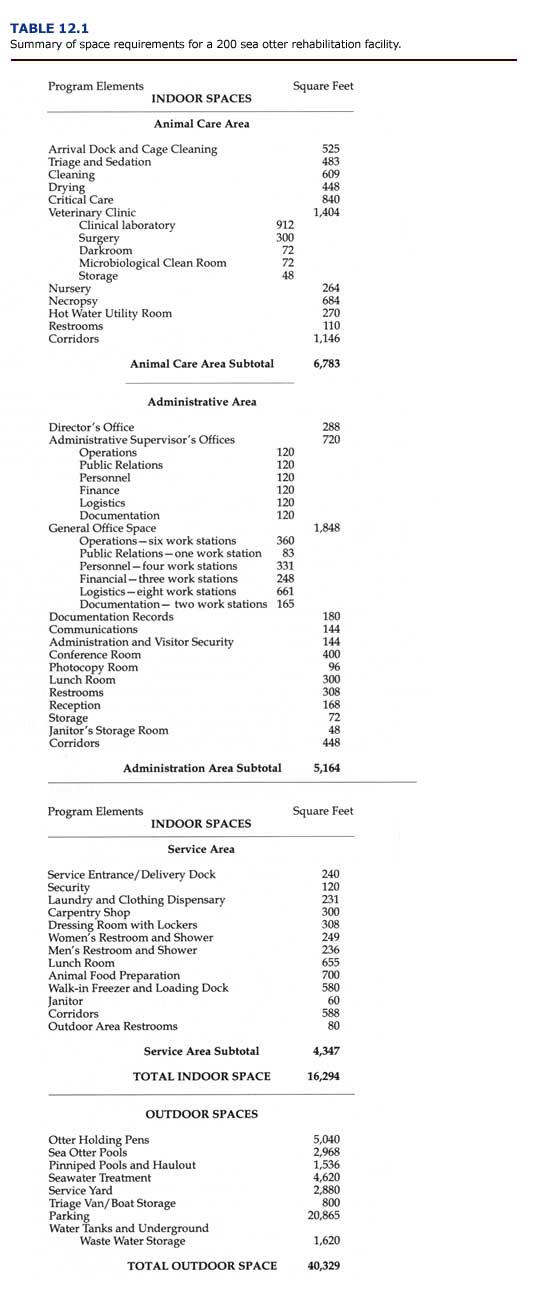
The space requirements and conceptual design of a regional sea otter rehabilitation facility are shown in Table 12.1 and Figure 12.1, respectively. This facility has a capacity of 200 otters, which is equal to the combined capacity of the two sea otter rehabilitation centers built during the EVOS. The indoor space is 16,294 ft2, and the outdoor space is 40,329 ft2. A facility of this size should be adequate for most moderate-to-large spills in areas with a large sea otter population. As oiled otters are rehabilitated and moved to a prerelease facility, space is made available for new arrivals.
When otters arrive at the regional center, they should be transferred to clean cages before rehabilitation begins. The transport cages are cleaned and sterilized in a dedicated wash room and then returned to the capture boats. The oiled sea otters are then moved in assembly-line fashion through areas for triage and sedation, cleaning and rinsing, drying, recovery and critical care, and short-term holding pens. Finally, otters that have restored the water repellency of their fur and are ready to be moved to a prerelease facility are placed temporarily in large pools. Because orphaned sea otter pups require specialized care, they are kept in a separate nursery area. A well-equipped veterinary clinic and surgical suite provide for essential medical care. Otters that die in the facility should be taken to the necropsy laboratory for a complete postmortem examination. The carcasses should be stored in a morgue freezer until their final disposition by the appropriate federal or state trustee (USFWS in Alaska and Washington State; the Department of Fish and Game in California).
To prevent the exposure of sea otters in the rehabilitation center to domestic animal diseases, the entire animal care area should be quarantined from the service and administrative areas. Staff entering the animal care area should wear clean coveralls and rubber boots. Visitors are prohibited from entering this part of the facility. Pets are prohibited within the entire facility at all times.
The administrative suite provides office space for the director, the supervisors, and the administrative staff (Chapter 13). Additional space is provided for plant security, communications, a conference room, photocopying, file storage, and a lunch area. A closed-circuit video system allows each room in the animal care area and the outdoor pen and pool area to be monitored by the director, the operations supervisor, plant security, and to be selectively displayed to visitors and the press in the conference room.
The service area is used for sea otter food storage and preparation, plant security for the service entrance, a carpentry shop, and a dressing room, lavatories, showers, and cafeteria for the animal care staff. Outdoor space is occupied by holding pens and pools for sea otters and pinnipeds, a seawater treatment facility, service yard, and parking. The entire rehabilitation facility requires 1.7 acres of land.
Arrival Dock and Cage Cleaning Room (525 ft2)
When oiled sea otters arrive at the rehabilitation facility, they should be delivered to the arrival dock in kennel cages. Quarantine procedures begin at this location. The kennel cages are cleaned and sterilized in the cage cleaning room (Appendix 4, Figure A Download PDF) before they are returned to the capture boats. This room is equipped with two stainless steel floor sinks equipped with steam or hot water hoses for cleaning cages, shelves for the storage of kennel cages, and a desk and file cabinet. The room is climate controlled, and the lighting fixtures are humidity resistant. The floor is covered with a nonporous, skid-resistant surface which slopes toward two floor drains. The walls are covered with ceramic tile. The waste water system has an oil trap. Doors lead to the triage room and the central corridor.
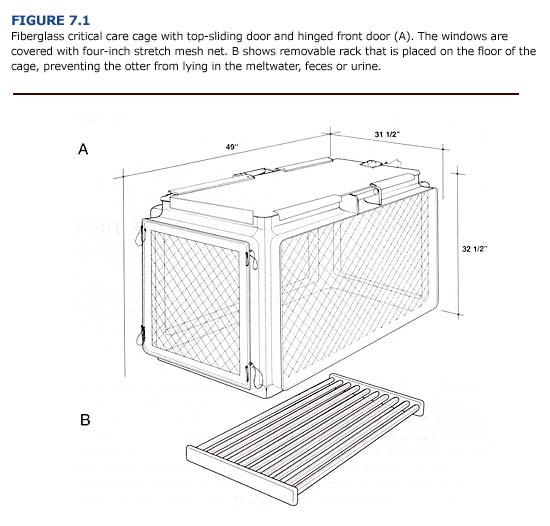
The kennel cages are carried from the loading dock through swinging doors into the triage room (Appendix 4, Figure B Download PDF). The otters are transferred to critical care cages (Chapter 7, Figure 7.1), and the dirty kennel cages are taken directly to the cage cleaning room through a second set of swinging double doors. The otters are weighed and examined to determine their priority for medical treatment. After medical stabilization, they are sedated (if required) prior to cleaning. This room is equipped with a digital floor scale for weighing otters, work counters with sinks, cabinets, a refrigerator, and a wall-mounted hose reel with hot and cold water for washing the floor. The floor is covered with a nonporous, skid-resistant surface which slopes toward a central floor drain. The room is climate controlled and maintained at a temperature of 20°C (68°F). The walls are covered with ceramic tile. The lighting fixtures are humidity resistant. A separate door leads to the central corridor.
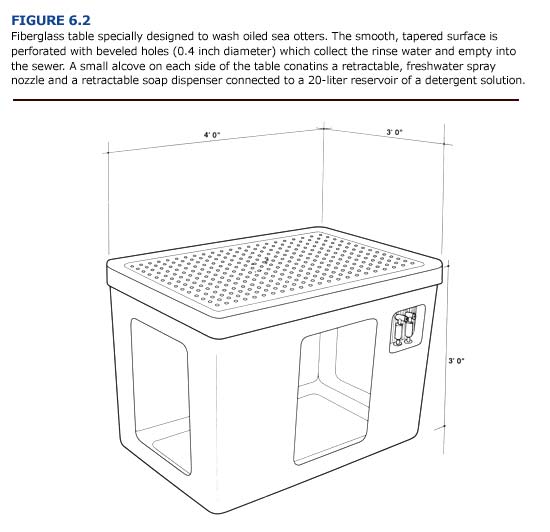
The cleaning room (Appendix 4, Figure B Download PDF) is designed for washing oiled sea otters with fresh water and detergent. Swinging doors lead from the triage room into the cleaning room. This room is equipped with five cleaning tables individually supplied with hot and cold water and detergent, work counters with sinks, cabinets, and a refrigerator. The specially designed cleaning tables have a perforated plastic surface that supports the sedated otter and allows detergent and water to fall into a basin that drains into a waste water system with an oil trap (see Chapter 6, Figure 6.2). The hot water system has a capacity of ten gallons per minute for each cleaning table. Clean towels are dispensed through a window between the cleaning room and the adjacent laundry room. Dirty towels are returned to the laundry room through a wall-mounted chute. The room is climate controlled and maintained at an air temperature of 20%B0C (68°F). The floor is covered with a nonporous, skid-resistant surface which slopes toward two floor drains. The walls are covered with ceramic tile. The lighting fixtures are humidity resistant. Dual swinging doors lead to the central corridor, and a second door leads to the laundry room.
After the otters are cleaned, they are taken across the corridor to the drying room (Appendix 4, Figure C Download PDF). This room has five drying tables, each of which is equipped with two high-speed, overhead, forced air pet dryers. The drying tables have smooth, perforated plastic surfaces that allow air to circulate from below. The room has a work counter with a sink and cabinets. The room is dehumidified and maintained at an air temperature of 20°C (68°F). The floor is covered with a nonporous, skid-resistant surface which slopes toward a central floor drain. The walls are covered with ceramic tile. The lighting fixtures are humidity resistant. A swinging door leads to the critical care room. A separate door provides direct access to the outdoor otter pens.
Otters that have been cleaned and dried should be allowed to recover from sedation in the critical care room (Appendix 4, Figure C Download PDF). Also, otters that are lightly oiled may be kept in this room for up to thirty-six hours before they are cleaned. Because otters that have been oiled and cleaned may have difficulty thermoregulating at ambient air temperatures, especially during the winter in northern latitudes, they should be kept in the critical care room until they are alert and have begun to groom. The otters are held in specially designed, fiberglass cages (Chapter 7, Figure 7.1) with sliding lids and smooth, slatted bottoms that allow the passage of feces and urine. Up to twenty-eight of these cages sit inside of shallow, stainless steel floor sinks (four feet wide) located along the walls. The floor sinks have a central drain and a hose reel with hot water so that they can be cleaned and sanitized. The center of the room has a work counter with three sinks, cabinets, and a refrigerator. The room is climate controlled and maintained at an air temperature of 15°C (60°F). The floor is covered with a nonporous, skid-resistant surface which slopes toward two floor drains. The walls are covered with ceramic tile. Doors lead to the veterinary clinic, the central corridor, and the outdoor otter pens.
The veterinary suite (Appendix 4, Figure D Download PDF) is designed for the clinical analysis of blood, fecal, and urine samples, storing and dispensing drugs and medical supplies, bacterial culture, and surgical procedures. Along with the clinical laboratory, the suite has a separate surgery room, a microbiological clean room, a darkroom for developing film, a medical storeroom, and an office area.
– Clinical Laboratory: Equipped with laboratory benches, sinks, cabinets, shelves, two desks, file cabinets, two refrigerators, and a -70°C freezer. 912 ft2
– Surgery: Equipped with a surgical table and light, gas anesthesia machine, x-ray machine, work counters with sinks, cabinets, and shelves. The floor is covered with a nonporous, skid-resistant surface which slopes toward a central drain. The walls are covered with ceramic tile. 300 ft2
– Darkroom: Area for an automatic x-ray film processing machine and for conventional film development. 72 ft2
– Microbiological Clean Room: Area equipped with a bacterial hood, shelves, and refrigerator. 72 ft2
– Medical Store Room: Locked room for storing drugs and medical supplies. 48 ft2
The nursery (Appendix 4, Figure D Download PDF) is designed for the care of captive-born and orphaned sea otter pups. The room provides a quiet environment in close proximity to the veterinary clinic. Amenities include a work counter with two sinks and cabinets, a refrigerator, an unheated waterbed for pups to play and rest on, and a shallow pool (3 ft x 10 ft x 2 ft deep). The floor is covered with a nonporous, skid-resistant surface which slopes toward a central floor drain. The room is climate controlled and maintained at a temperature of 15°C (60°F). The walls are covered with ceramic tile. Separate doors provide access to the central corridor and the veterinary clinic.
The necropsy room (Appendix 4, Figure E Download PDF) is used for the postmortem examination of sea otters and the preparation of necropsy reports. The room is equipped with work counters and cabinets, three stainless steel sinks, heavy-duty sink-mounted garbage disposal, horizontal exhaust dissection table, fume hood, specimen photographic booth, stainless steel necropsy table with light, walk-in freezer (96 ft2), -70°C freezer, refrigerator, morgue refrigerator, lavatory with toilet, lockers, shower and dressing area, and a desk and file cabinet. The floor is covered with a nonporous, skid-resistant surface which slopes toward a central drain. The walls are covered with ceramic tile. The room is climate controlled. Direct access is provided to the outside of the facility for waste disposal and for the delivery and removal of dead animals. A second door leads to the central corridor.
This area houses the gas-fired, instantaneous water heaters for sea otter cleaning (Appendix 4, Figure A Download PDF). For the remainder of the facility, large commercial water heaters should be used. A steam-generating boiler should also be installed for steam cleaning the oily cages in the adjacent cage cleaning room. Direct access is provided to the outside of the facility for maintenance of the heating equipment.
Men’s and women’s restrooms in the animal care area.
(Appendix 4, Figure F Download PDF)
Director’s Office (288 ft2)
Office area for the facility director and his secretary. The area can also be used for small conferences with administrative staff and the press. Windows along the exterior wall provide a view of outdoor otter pens and pools.
Offices for following administrative supervisors:
Operations (120 ft2)
Public Relations (120 ft2)
Personnel (120 ft2)
Financial (120 ft2)
Logistics (120 ft2)
Documentation (120 ft2)
General office space for the following personnel:
Operations – six work stations (360 ft2)
Public Relations – one work station (83 ft2)
Personnel- four work stations (331 ft2)
Financial- three work stations (248 ft2)
A room for six telephones, radio communications equipment, and telefax machine. This room is essential for good communications during an oil spill.
.
Area for management of plant security. The room is equipped with the main security system control panel and guard station with desk. A closed-circuit video system enables the security coordinator to monitor entry gates, hallways, all rooms in the animal care area, and the outdoor pens and pools. All persons working in the facility should wear photo-identification badges issued by security.
This large room is used for general meetings and press conferences. Windows enable visitors to view the outdoor otter pens and pools while maintaining animal quarantine. The closed-circuit video system enables visitors to view operations within the facility without entering the quarantine area. The room is equipped with a projection screen and presentation board.
Area for making photocopies and storing supplies.
The administrative staff lunch room is equipped with tables, counters, sink, and refrigerator. The capacity of the lunch room is sixteen persons.
Men’s and women’s restrooms for administrative offices.
Area for visitors to be received and cleared by security.
General storage for stationery, computer, and photocopy supplies.
Room for storing of janitor’s equipment and supplies.
(Appendix 4, Figures G, H, and I Download PDF)
Service Entrance/Delivery Dock (240 ft2)
Area for animal care staff to enter the facility and for the delivery of supplies and equipment.
Animal care staff arriving for work should display their photo-identification badges at the security desk before entering the facility. This room is equipped with a security control panel, guard station, desk, and storage shelves. Windows provide good visual control over the entry and delivery area. Direct access is provided to the main corridor.
Animal care staff should proceed from the security area to the clothing dispensary room to pick up their clean coveralls and rubber boots, and then proceed to the locker room. Soiled coveralls are returned to the clothing dispensary room after the staff complete their shift. Soiled coveralls and towels from the cleaning room are washed in the laundry room (or sent to a commercial laundry company).
Maintenance and service shop equipped with a full range of power tools and work benches. Direct access is provided through double doors to the service yard and the delivery dock.
Area for animal care staff to change into clean coveralls and rubber boots and to store articles of personal clothing. This room is equipped with benches and 132 lockers for personal storage. The floor is covered with a nonporous, skid-resistant surface.
Restroom adjacent to dressing area with three toilets, two lavatories, and two showers.
Restroom adjacent to dressing area with two toilets, two urinals, two lavatories, and two showers.
Common area for animal care staff to eat meals, socialize, and observe otters in pens and pools. The seating capacity is fifty-four persons. Direct access is provided to the pools and pens, and windows along the two exterior walls provide a good view of the pen area. This room is equipped with kitchen facilities, including tables, catered food service counter, cabinets, sink, and refrigerator.
The animal food preparation room (Appendix 4, Figure H Download PDF) is used for thawing frozen seafood and preweighing individual food portions. In a rehabilitation facility with 200 adult otters, the kitchen staff will thaw and prepare 1000 kg of sea food daily. This kitchen is equipped with two stainless steel counters with heavy duty garbage disposals, eight stainless steel thawing sinks (3 ft x 3 ft x 3 ft deep), cabinets, two commercial ice machines, and a commercial refrigerator. An office (50 ft2) with a desk and file cabinet is provided for the food preparation coordinator. The floor is covered with a nonporous, skid-resistant surface and slopes toward two central floor drains. The walls are covered with ceramic tile. Animal care staff pick up buckets of iced seafood at a counter located along the exterior wall. Separate doors provide access to the service yard, central corridor, and outdoor pen and pool area.
This walk-in freezer is large enough to store a ten day supply of frozen seafood. The freezer is located next to the food preparation kitchen and has direct access to the service yard for deliveries of frozen seafood.
Room for storing of janitor’s equipment and supplies.
Men’s and women’s restrooms for outdoor pen and pool area.
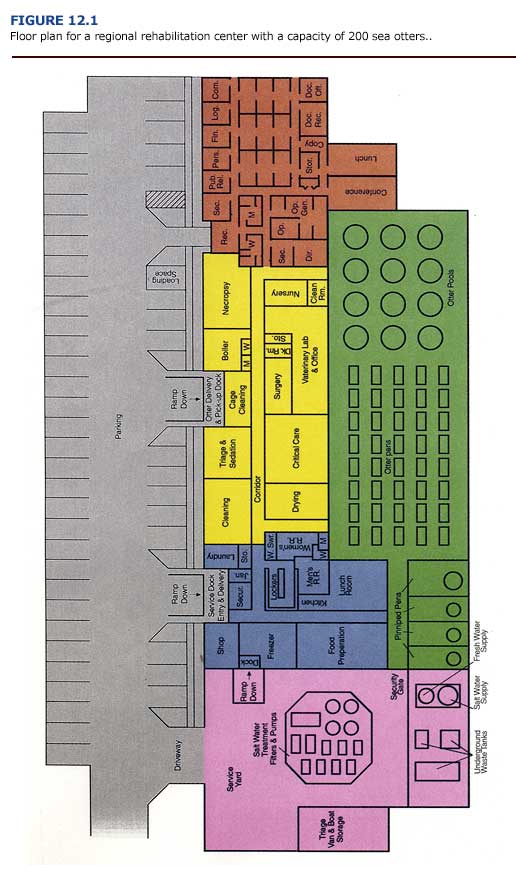
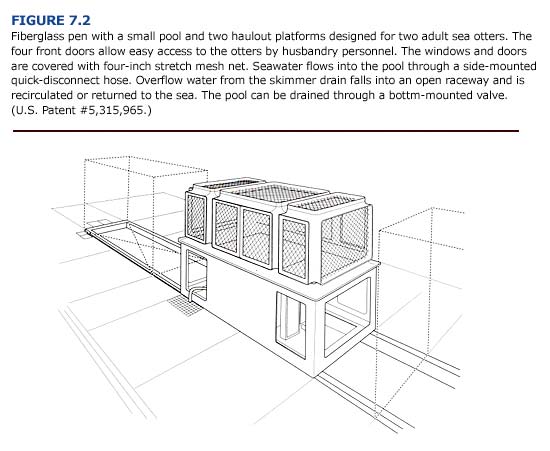
Once sea otters in the critical care area have recovered from sedation, have a stable core temperature, and have begun to feed, they should be moved to outdoor holding pens (Chapter 7, Figure 7.2). This outdoor area is designed for forty fiberglass pens (Figure 12.1) to house eighty sea otters. Each row of pens sits above a shallow concrete trough that catches the seawater overflow from the pens and returns it to the recirculation system. Two-foot-wide covered utility raceways are located between each row of pens to provide for hot (33°C, 92°F) and cold seawater connections. The seawater temperature in each pen should be adjustable to meet the needs of individual otters. The seawater turnover rate in each pen should be once every thirty minutes. The pen area is easily accessible from the critical care room, veterinary clinic, and service yard.
Once the recuperating otters have restored the water repellency of their fur and are in good health, they should be moved from the outdoor pens to larger pools that enable greater movement. The fiberglass pools are fourteen feet in diameter, four feet deep, and can hold up to six sea otters (Chapter 7, Figure 7.4). The perimeter of each pool has a three-foot-wide haul out area and is surrounded by a plastic-coated chain link fence to prevent the otters from escaping. Exterior stairs provide access to the pools and haul out areas. The seawater turnover rate in the pools is once every thirty minutes.
This area is designed for holding pinnipeds (seals and sea lions) that have been oiled and cleaned. The rehabilitation process for pinnipeds is similar to that for sea otters (see Chapter 15). The area is paved with concrete, subdivided with chain link fences, and has four round fiberglass pools (three six-foot diameter pools and one eight-foot diameter pool). The seawater turnover rate in the pools is once every sixty minutes.
This area for seawater filters, ozonation tower, pumps, and heat exchanger is easily accessible from the service yard for equipment maintenance and service. Total seawater recirculation capacity is 2,000 gallons per minute. To prevent the spread of disease, the otter pen area, rectangular pools, and pinniped pools should have separate seawater systems. Each of these three areas has its own seawater filtration system and ozonation tower. Only the sea otter pens have a heated seawater supply.
Asphalt-surfaced service yard with direct access to seawater treatment area, walk-in freezer, and carpentry shop.
Asphalt-surfaced storage area surrounded by a chain link fence for the storage of two mobile triage trailers and two skiffs.
Asphalt-surfaced parking area for fifty automobiles located at the front of the rehabilitation facility.
Normally about two weeks are required to rehabilitate an oiled sea otter; although the duration may be longer for animals with serious health problems. Rehabilitated otters should be moved from the regional rehabilitation center to seawater pens in a prerelease facility as soon as their fur is water repellent and they are healthy. Because of the many factors that may influence the timing of release (see Chapter 10), prerelease facilities may be needed to hold sea otters for up to six months. As part of prespill contingency planning, possible sites for prerelease facilities should be identified.
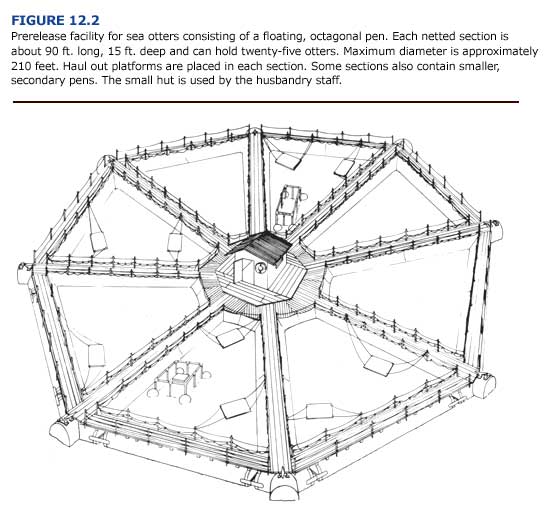
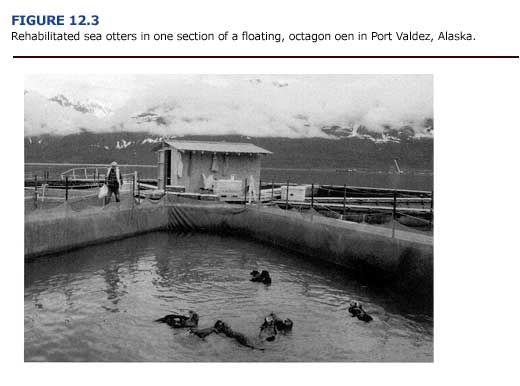
Holding pens in the prerelease facility should be large enough for the otters to swim and dive (at least 18 ft long, 10 ft wide, 5 ft deep) and have good seawater circulation. An octagonally shaped floating pen that can hold up to 200 sea otters was used during the EVOS. (Figures 12.2 and 12.3.) The spokes and perimeter of this pen are made of steel pipe (four foot diameter) that form flexible junctures when assembled. This type of construction allows the structure to bend and ride over waves. Each pie-shaped section is draped with netting (four inch stretch mesh) that is secured four feet above the water line. Floating, wooden platforms provide haul out space for the otters. A small hut in the center provides protection from the weather for the animal monitors.
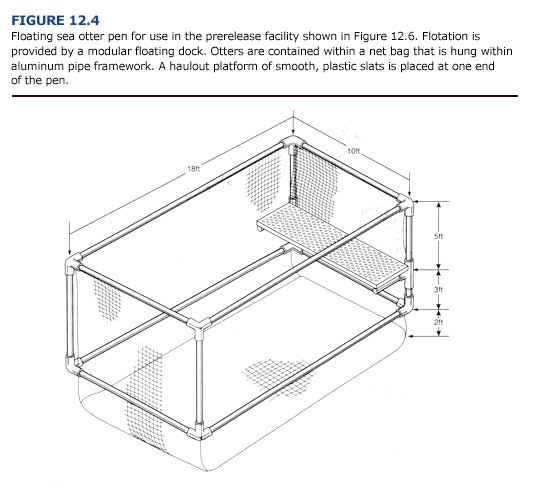
A less expensive prerelease facility with a 100 otter capacity can be made from a modular, floating dock ( JETFLOATTM ), Vancouver, B.C.) and twelve floating pens (Figures 12.4, 12.5, and 12.6). The pens (18 ft x 10 ft x 5 ft deep) are made out of aluminum pipe and net (2.0 inch stretch mesh on sides); the pens are secured to cleats on the floating dock. Each pen has a haul out platform (10 ft x 3 ft) made of smooth, plastic slats spaced one inch apart.
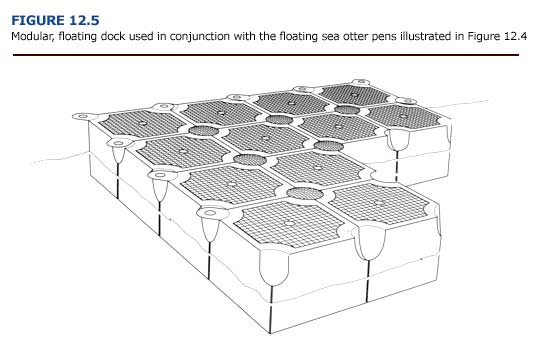

Other space requirements for the prerelease facility, but not necessarily located on the floating dock, include a food preparation area, freezers, a small veterinary clinic, administration and records, communications, an area for staff to change into sanitary clothing, and staff accommodations. Depending on the accessibility of the site by road, a helicopter pad and boat dock may be required on shore for the delivery of sea otters, staff, and provisions. Security is essential to prevent visitors and pets from entering the facility. As with the regional rehabilitation center, full quarantine procedures are maintained within the prerelease facility to prevent the introduction of domestic animal diseases.
If a large preemptive capture effort is planned after a spill (see Chapter 2), quick access to seawater pens in a prerelease facility is vital. Modular systems like the ones above will allow staff to quickly assemble the pens when needed. A modular design also enables the addition of new pens as needed, thereby allowing unlimited capacity.
Transporting sea otters over long distances is stressful. For otters that have been exposed to oil, this stress can cause death or seriously complicate medical conditions. Mobile triage units are beneficial in certain cases because they allow staff to stabilize the animals medically before they are flown long distances to a regional rehabilitation center. Mortality can be reduced significantly if mobile units are employed when large numbers of otters must be captured more than 500 miles (five-hour helicopter flight) from the regional center.
These mobile units, by necessity, are self-contained (including electrical generators and hot water) and transportable by truck, ship, large helicopters, or fixed-wing aircraft (C-130 cargo plane); the latter may be necessary for areas inaccessible by road such as the Aleutian Islands or southeast Alaska. A mobile facility (Figure 12.7) should consist of a trailer (10 ft wide, 33 ft long) that is divided into three functional sections. The largest section is for triage and can hold up to eight otters in portable cages until they can be flown to the regional center. Otters arriving from the capture boats are examined by a veterinarian or animal care specialist and treated for hypothermia, dehydration, malnourishment, capture stress, or other medical problems. After they are medically stabilized, the otters are placed in critical care cages (Chapter 7, Figure 7.1) and monitored. The cages are placed in a shallow, fiberglass floor sink that collects waste water and drains into the sewer or a storage tank. A hose can be used to rinse the cages and the floor sink. Because heavily oiled otters have lost their ability to thermoregulate at cold temperatures, the room should be maintained at about 15°C (60°F). However, the otters should also be checked regularly to ensure that they are not overheating.
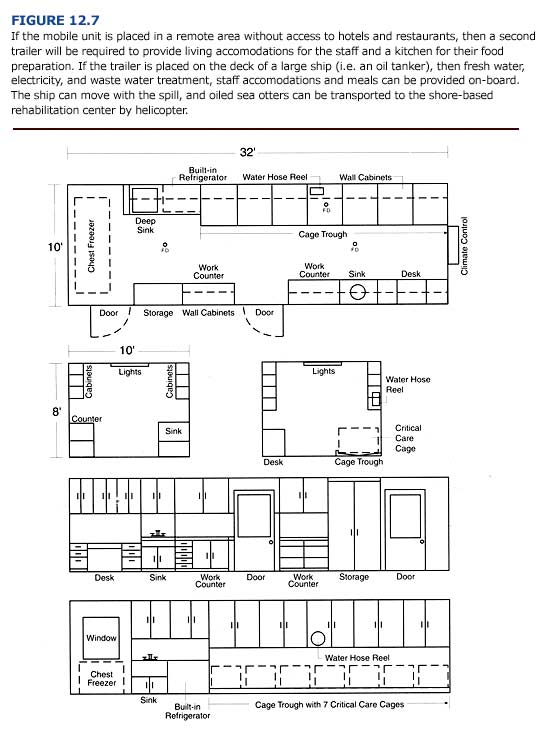
The triage area includes space for clinical blood analysis, communication equipment, and a desk. Blood samples from newly arrived otters should be analyzed for metabolites, electrolytes, and hematological variables. This information is vital for veterinarians to diagnose and treat immediate medical problems (see Chapter 4). This area is also used to store clinical supplies and drugs. Hot water is provided by a wall-mounted, propane-fueled instantaneous water heater. Communication equipment should include of a VHF radio and telephone (cellular telephones are very useful in areas with service). Good communication between the mobile facility and capture boats, helicopter, and the regional rehabilitation facility is vital. Administrative and animal health records are also kept in this area.
The other end of the trailer is used for sea otter food preparation. This kitchen is a smaller version of the one at the regional facility, consisting of a stainless steel counter for food preparation, a deep sink with fresh water for thawing frozen seafood, and a chest freezer (25 ft3). This is enough freezer space to store one week of food for ten adult sea otters.
The trailer should be designed with external connections for water, electricity, propane, and sewage. If these amenities are not available at the site, then backup systems are required. These consist of fifty-gallon portable storage tanks for fresh water and a 5kW diesel-electric generator with a fifty-gallon fuel tank. The generator should be housed separately in a noise-insulated, weatherproof container. In remote areas where sewage treatment is unavailable, waste water from the kitchen and sea otter holding area can be drained onto the ground by running a hose several hundred feet from the trailer. The waste water should contain only nontoxic, biodegradable substances such as food and feces. Portable propane tanks should be used for the instantaneous hot water heaters and space heaters. Additional outdoor space for holding sea otters in cages, storing equipment, and for conducting other activities that require shelter can be provided by portable, vinyl enclosures similar to those made by Weatherport Company (Anchorage, Alaska).
If the mobile unit is placed in a remote area without access to hotels and restaurants, then a second trailer will be required to provide living accommodations for the staff and a kitchen for their food preparation. If the trailer is placed on the deck of a large ship (i.e. an oil tanker), then fresh water, electricity, and waste water treatment, staff accommodations and meals can be provided on-board. The ship can move with the spill, and oiled sea otters can be transported to the shore-based rehabilitation center by helicopter.
The role of management is to ensure that the rehabilitation program is properly implemented. The management structure should be organized before an oil spill and executed by experienced professionals. Although the management style should be interactive and encourage the free exchange of information and ideas, staff members should understand the chain-of-command, rules of employment, and their job responsibilities.
This chapter describes the management structure and staff requirements for large rescue and rehabilitation programs involving fifty or more sea otters. For spills involving fewer than fifty otters, the number of personnel can be reduced as appropriate by assigning more than one job to each staff member.
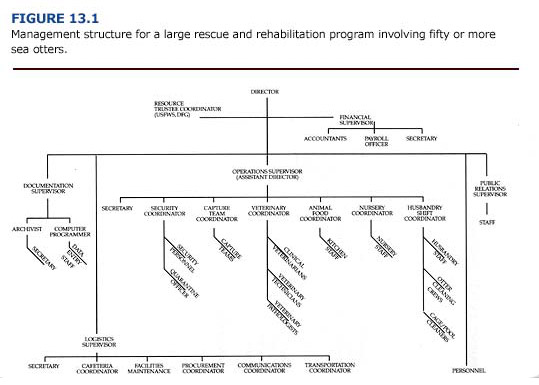
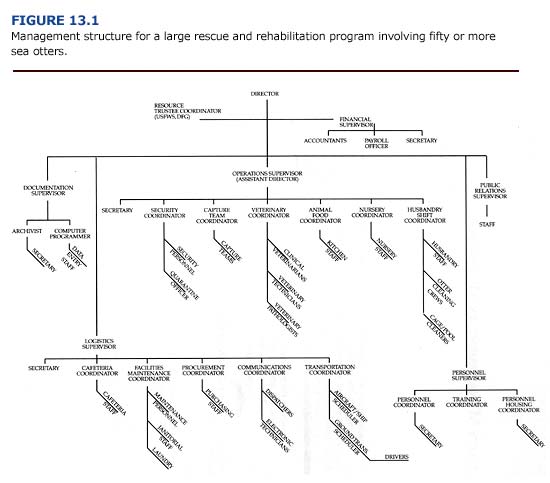
The director is responsible for the overall rescue and rehabilitation program, its facilities, and its staff (Figure 13.1). He or she should understand the effects of oil on sea otters and, ideally, have experience in every phase of the rescue and rehabilitation process. Management experience and good interpersonal skills also are important. The ultimate success of the rehabilitation program will depend on the expertise and experience of the management team the director assembles.
The director is ultimately responsible for operating the rehabilitation program, but is usually occupied with matters other than the daily operations of the facility. He must be responsive to the needs and desires of the spiller (if one is identified) and government officials, including the trustee resource agencies- U.S. Fish and Wildlife Service (USFWS) and the Department of Fish and Game (DFG), the on-scene coordinator, and the regional response team. Other demands on his time will come from special interest groups and the media. The director will have time to deal with these groups professionally and effectively only if he is confident about daily operations; this confidence will come only through good management and a well-trained staff.
Because sea otters are protected under the Marine Mammal Protection Act of 1972, the director must receive authority from the USFWS for their capture, rehabilitation, and release. Under emergency conditions such as an oil spill, provisional authorization can be provided quickly to individuals with recognized expertise and experience. However, to avoid confusion and delays, the director should obtain preauthorization for sea otter rehabilitation from the USFWS.
During an oil spill, a USFWS coordinator may be designated to provide trustee agency oversight of the rescue and rehabilitation program. This coordinator may direct the capture operations through the capture team coordinator (see below), who is a member of the management team and also may be an employee of the trustee agency. Such an arrangement ensures direct communications between the capture teams in the field and the trustee agency on such important issues as the preemptive capture of unoiled otters and when to begin and end the capture operation.
The director may not be involved in the daily operations of the rehabilitation center, but must remain informed about the status of the facility and any problems that require his personal attention. This can be accomplished through daily meetings with the management team, which includes a financial supervisor, operations supervisor, logistics supervisor, personnel supervisor, documentation supervisor, and public relations supervisor. Their feedback is essential to ensure efficient and effective operations. To manage rehabilitation program finances, the director should meet daily with the financial supervisor, review the accounts, and approve all purchase requests. The hire and discharge of any personnel should be reviewed with the operations supervisor and the personnel supervisor. In the director’s absence, the operations supervisor should become acting director.
Good media relations are essential during an oil spill. Because many people find sea otters appealing, the press will be very interested in the well-being of otters in the rehabilitation center. The director should meet daily with the spiller, the USFWS, and the public relations supervisor to organize press briefings and interviews. Alternatively, if the spill is under federal control, media relations may be coordinated by the USFWS and the on-scene coordinator.
The financial supervisor is responsible for maintaining financial records, preparing payroll, and approving all purchase requests, leases, and contracts. Staff accountants, the payroll officer, and secretarial staff will assist this individual (Figure 13.1). The accountants maintain a current balance on all expenditures. The payroll officer distributes and collects employee time cards from respective supervisors, verifies employee working hours, and prepares the payroll. Purchase requests for supplies and equipment should be submitted through each supervisor to the procurement coordinator, who must receive approval from the financial supervisor or a designated accountant before placing the order. Copies of all purchase vouchers are sent to the accountants.
In some instances, the financial supervisor may be an employee of the responsible party paying for the rescue and rehabilitation program. Under these circumstances, the financial supervisor acts as a liaison between the rehabilitation program and the responsible party’s financial office, which must approve all expenditures.
The operations supervisor is responsible for the cleaning, husbandry, feeding, and veterinary care of sea otters in the rehabilitation center, as well as for organizing capture teams, ensuring they are properly trained, and coordinating capture efforts with the USFWS. The operations supervisor is also responsible for security and maintaining quarantine conditions at the center. When the director is absent, the operations supervisor should become acting director of the rescue and rehabilitation program. This supervisor relies on the husbandry coordinator, nursery coordinator, animal food coordinator, veterinary coordinator, capture team coordinator, and security coordinator to fulfill these responsibilities (Figure 13.1). Personnel supervised may include husbandry staff, sea otter cleaning crews, cage and pool cleaners, nursery staff, kitchen staff, clinical veterinarians, veterinary pathologists, veterinary technicians, capture teams, security personnel, the quarantine officer, and secretarial staff.
The operations supervisor works with the personnel supervisor to ensure that the animal care staff and capture teams are properly trained and clothed (see Chapter 14). He relies on the husbandry coordinator, nursery coordinator, and animal food coordinator to ensure that proper husbandry protocols (see Chapter 7) and safety procedures (see Chapter 14) are followed.
The husbandry coordinator supervises the husbandry staff who monitor and feed the otters, the sea otter cleaning crews who wash and dry the oiled otters, and the cage and pool cleaning crews. The husbandry coordinator works with the documentation supervisor to ensure that proper records (see Appendix 2 Download PDF for record forms) are maintained by the husbandry staff and that each otter can be identified by its flipper tag. Three eight-hour shifts are required to provide the otters with continuous care. Depending on the number of oiled otters arriving at the rehabilitation center, up to three eight-hour shifts will be needed for the sea otter cleaning crews. Cage and pool cleaning crews should work only one shift during the day.
The nursery staff coordinator supervises the nursery personnel who care for orphaned sea otter pups. The care of sea otter pups is very labor intensive and requires a well-trained and dedicated staff. Three eight-hour shifts are needed to care for the pups.
The animal food coordinator supervises the kitchen staff who prepare the frozen or fresh seafood for the otters. Only a daytime and evening shift are needed for the kitchen staff, because the otters are not fed between midnight and 7:00 AM.
The veterinary coordinator supervises the veterinary staff to ensure that the otters receive prompt medical care on a twenty-four-hour basis. Three eight-hour shifts are needed for the clinical veterinarians and veterinarian technicians. All otters that die in the center should be necropsied within two hours by a veterinary pathologist and tissue samples taken for toxicological and histopathological analysis (see Chapter 1). The USFWS may provide a veterinarian to conduct or supervise the necropsies and tissue collections. This person may also assist the clinical veterinarians in verifying that rehabilitated otters are healthy, disease-free, and ready for release.
The husbandry coordinator, animal food coordinator, and veterinary coordinator maintain inventories of essential equipment, supplies, and seafood. When shortages are identified, purchase requests are given to the operations supervisor, who forwards them to the procurement coordinator. The animal food coordinator and the veterinary coordinator should institute quality control procedures for all perishable supplies, especially seafood and drugs.
The capture team coordinator directs capture operations and works with the personnel supervisor to ensure that capture teams are properly trained. As mentioned above, this person may be the USFWS coordinator. The capture team coordinator works with the transportation coordinator, communications coordinator, procurement coordinator, and the USFWS coordinator to ensure that capture boats are chartered and that capture efforts are properly coordinated with the aircraft or ship-based transportation of sea otters, personnel, and supplies. Good communication (by radio or cellular telephone) with the capture boats is vital to ensure the prompt transportation of newly captured sea otters to the rehabilitation center.
The security coordinator controls the movement of personnel into and out of the facility by placing security guards at all entrances and issuing photo-identification badges to all personnel. These security procedures are needed to prevent the accidental introduction of domestic animal diseases into the animal quarantine area by unauthorized visitors. To ensure that the quarantine is maintained, a veterinarian or a trained specialist with expertise in quarantine procedures for domestic animal diseases will, as the quarantine officer, assist the security coordinator.
The logistics supervisor is responsible for chartering capture vessels and crews, transporting personnel and animals, maintaining communications between the rehabilitation center and field operations, procuring equipment and supplies, maintaining the facilities and equipment, and, in remote areas, feeding the staff. This person relies on a transportation coordinator, a communications coordinator, a procurement coordinator for supplies and equipment, a facilities maintenance coordinator, and a cafeteria coordinator (Figure 13.1). Under the logistics supervisor are the aircraft and ship scheduler, the ground transportation scheduler, drivers, radio and cellular telephone dispatchers, electronic technicians, purchasing staff, maintenance personnel, janitorial and laundry staff, cafeteria staff, and secretaries.
The transportation coordinator charters or leases boats, helicopters, fixed-wing aircraft, trucks, vans, and cars. This includes leasing cars or trucks for use by the director, supervisors, and other key personnel. The transportation coordinator relies on the ship and aircraft scheduler to coordinate the aircraft or ship-based transportation of sea otters, personnel and supplies between the capture boats and an airport or harbor. The ground transportation scheduler arranges for the transportation of otters, personnel and supplies by van, truck, or car to and from the rehabilitation center, relying on a team of drivers who maintain radio contact with dispatchers in the communications room.
The communications coordinator should establish a radio and cellular telephone communications network between the capture boats, aircraft, ground transportation, and the rehabilitation center. Supervisors and other key personnel should carry hand-held radios and wear pagers so they can be contacted twenty-four hours a day. A dedicated communications room should be established in the rehabilitation center to coordinate communications with all field operations. The communications coordinator should use dispatchers to transmit and receive information and trained communications technicians to keep the equipment operational. The inability to reliably communicate with the capture boats greatly impeded the sea otter rescue effort during the Exxon Valdez oil spill (EVOS).
The procurement coordinator for supplies and equipment is responsible for locating vendors and preparing purchase vouchers for all equipment and supplies. Purchase requests should be received through the appropriate supervisor before a voucher is prepared. The voucher is then approved by the financial supervisor and a copy sent to his office after an order is placed with a vendor.
The facilities maintenance coordinator ensures that the rehabilitation facility and its equipment are in good operating condition. This includes the physical structure, all amenities (lighting, climate control, plumbing, the seawater system, etc.), outdoor pens and pools, and the landscaping. This person works with the operations supervisor and staff to establish maintenance priorities for the facility. Maintenance work can be conducted by in-house staff or independent contractors. If contractors are used, the facilities maintenance coordinator should negotiate maintenance agreements before a spill occurs. This will help ensure prompt service and a more competitive price. All maintenance agreements must be approved by the financial supervisor. The facilities maintenance coordinator also supervises the janitorial and the laundry staff, who keep the facility interior clean and wash the towels and coveralls used by the animal care staff.
In remote areas, the cafeteria coordinator is responsible for feeding personnel at the rehabilitation facility, relying on the cafeteria staff to prepare or cater the meals which should be served in a sanitary room separate from the animal care area (see Chapter 12). The cafeteria coordinator works with the procurement coordinator to purchase food and supplies.
The personnel supervisor is responsible for hiring, discharging, and ensuring that personnel are trained in accordance with Occupational Safety and Health Administration (OSHA) standards (see Chapter 14). For spills in remote areas, this person also is responsible for staff housing. This supervisor relies on the personnel coordinator, training coordinator, personnel housing coordinator, and secretarial staff (Figure 13.1).
The personnel coordinator works with the operations supervisor and logistics supervisor to determine the number and type of personnel needed in the rehabilitation center and on the capture boats. This person actively recruits paid and volunteer staff during an oil spill response (see below), maintains personnel records, and works with the payroll officer to administer payroll.
The training coordinator works with the operations supervisor and capture team coordinator to ensure that all personnel receive specific job training according to OSHA standards before commencing work, and that they understand their employee responsibilities and rights. To avoid labor disputes and possible lawsuits, a personnel handbook should be prepared. The handbook should clearly describe the rules of employment, including job responsibilities, the chain-of-command, proper attire, safety, hygiene, benefits (health and disability insurance), overtime, promotion, and dismissal.
If the spill occurs in a remote area, the personnel housing coordinator is responsible for staff housing. This may be accomplished by arranging for staff to stay in private homes, leasing apartments or condominiums, bringing in trailers, or constructing temporary buildings.
The documentation supervisor ensures that: 1) sea otters are properly identified when captured, 2) data forms are completed, filed, and copies sent to the USFWS, and 3) data is entered into a computer database, analyzed, and made available to appropriate staff at the rehabilitation center. To accomplish this, the documentation supervisor relies on an archivist, computer programmer, and data entry personnel.
The documentation supervisor works with the training coordinator to ensure that capture teams, husbandry staff, and veterinarians understand documentation forms used during the capture, rehabilitation, clinical care, necropsy, release, and transfer of sea otters (see Appendix 2 Download PDF). This person also works with the capture team coordinator and husbandry shift coordinator to ensure that each otter is identified with a flipper tag for tracking from capture until release, transfer, or death.
The archivist maintains all records and distributes copies to the USFWS. The computer programmer maintains a computer database, supervises the entry of all data, and prepares daily status reports on the number of otters in the facility, their food consumption, and medical condition. This person also assists supervisors in maintaining computer hardware and software.
The public relations supervisor works with the director, the spiller, the on-scene coordinator, and the USFWS to coordinate daily press briefings and media interviews.
The press will request access to the rehabilitation facility to photograph and videotape the otters and staff. This poses several serious problems. First, the presence of visitors makes it difficult to quarantine animals and increases the risk of exposure to domestic animal diseases. Second, the added commotion is stressful to the otters. Organizing a press pool (a single representative for the entire press group) is one solution. Alternatively, the facility should be designed with viewing areas that are isolated from the animal care area by glass (see Chapter 12). Video cameras may be placed in key locations throughout the facility so that visitors can view the rehabilitation process on video monitors outside of the quarantine area.
Oiled sea otters require care twenty-four hours a day, so a core professional staff of administrators, veterinarians, veterinary technicians, and animal care specialists is required (Table 13.1). The support staff should be large enough for three eight-hour shifts so that the otters receive continuous care. Some overlap in shifts will allow the exchange of information among staff members, especially the husbandry staff.
The appropriate staff size will depend on the number and health of the otters in the facility. At the beginning of a spill when capture teams are in full operation and heavily oiled otters require intensive care (one animal monitor per three otters), the number of personnel will range from 137 to 392 for facilities with capacities of 50 to 200 sea otters, respectively (Table 13.1). After capture operations end and the rehabilitated otters require less care (one animal monitor per ten otters), the staff can be decreased by fifty percent or more. Staff reductions should occur in accordance with efficient management of the facility and husbandry needs of the otters. At the time of their employment, all personnel should be told that the rescue program is temporary, and that their jobs will be terminated as the otters are rehabilitated and released.
Oiled sea otters require care twenty-four hours a day, so a core professional staff of administrators, veterinarians, veterinary technicians, and animal care specialists is required (Table 13.1). The support staff should be large enough for three eight-hour shifts so that the otters receive continuous care. Some overlap in shifts will allow the exchange of information among staff members, especially the husbandry staff.
The appropriate staff size will depend on the number and health of the otters in the facility. At the beginning of a spill when capture teams are in full operation and heavily oiled otters require intensive care (one animal monitor per three otters), the number of personnel will range from 137 to 392 for facilities with capacities of 50 to 200 sea otters, respectively (Table 13.1). After capture operations end and the rehabilitated otters require less care (one animal monitor per ten otters), the staff can be decreased by fifty percent or more. Staff reductions should occur in accordance with efficient management of the facility and husbandry needs of the otters. At the time of their employment, all personnel should be told that the rescue program is temporary, and that their jobs will be terminated as the otters are rehabilitated and released.
Good management is essential for a successful rescue and rehabilitation program. Because the rehabilitation team must respond quickly, a well-designed management structure should be organized before an oil spill. Personnel requirements will change during the course of a spill and will depend on the number and health of the otters in the rehabilitation facility. If properly trained and supervised, volunteers can be a valuable source of manpower and enthusiasm for the labor intensive task of caring for oiled sea otters.