ch9-triage

Triage and Stabilization

If a pup arrives at the rehabilitation center with its mother or is born in the center, it should not be separated from the female unless its health is in jeopardy. Survival may be greatly enhanced if it receives colostrum from a healthy female during the earliest stages of nursing. However, care should be taken to avoid possible petroleum hydrocarbon transfer from an oiled female to her pup through contaminated colostrum. (See Chapter 8.)

An initial clinical examination is recommended to assess the pup’s body condition and overall health. The following information should be recorded: capture date and location, body weight, standard length, axillary girth, sex, and age. If age is unknown, the body weight provides a rough indication: pups weighing 1-7 kg are usually less than three months old; pups weighing 7-20 kg are usually three to eight months old. For those experienced in handling sea otter pups, dentition, pelage, and behavior can provide additional information to estimate age. A daily record should be maintained on each pup’s health status, food consumption, fur condition, and behavior (Appendix 2, Form M Download PDF).

During the initial examination, behavior should be noted: normal (alert and responsive); depressed (unresponsive to external stimulation but conscious); comatose (unconscious). The fur should be examined to determine whether it is clean or contaminated with oil, feces, or dirt. The presence and location of lacerations or other lesions should be recorded. The sea otter pup’s thermoregulatory ability is limited, and body temperature should be carefully monitored with an electronic digital thermometer with a flexible probe inserted 1-3 cm into the rectum. Rectal temperature should be measured during physical examinations and prior to any medical treatments. Normal values range from 37.5-38.1° (99.5-100.6°F) (Williams and Kocher, 1978).

Respiratory rate can be determined by observing movements of the chest wall and is normally 17-20 breaths/ minute (Williams and Kocher, 1978). The heart rate is determined by auscultation or palpation of the chest and is normally 144-159 beats/minute. A 6 ml blood sample should be taken from the proximal third of the femoral vein with a 19 gauge, l-inch needle. Hematology and blood chemistry should be measured and compared with normal values to assess the pup’s health (see Appendix 1 Download PDF).

Sea otter pups should be treated prophylactically on admission with penicillin (20,000 units/kg sid IM), gentamicin (1 mg/kg/ day sid IM for the first five days), and lactated Ringer’s solution (15 ml/kg/ day SQ) with vitamin B-complex added (2 ml/L) for the first three weeks or as needed. Medication is usually given subcutaneously between the shoulders or intramuscularly in the rear limb.

ch9-Cleaning and Restoring Oiled Pup Fur

Cleaning and Restoring Oiled Pup Fur

Small amounts of crude oil should be removed with a cloth moistened with DawnTM detergent and water in a 1:16 dilution. When possible, residual detergent should be removed with a moist towel. Heavily oiled pups should be cleaned with water at 38°C (100°F) and dilute DawnTM detergent and then thoroughly rinsed.

After cleaning, the fur should be blown dry at room temperature and combed to prevent matting (see Husbandry section below). Rectal temperature should be monitored frequently during the cleaning procedure.

ch9-clinical

Clinical Treatment

Shock

Shock is often observed when pups arrive at the rehabilitation center. The pups will appear lethargic or comatose and may not have nursed for many hours. This life threatening condition is often caused by dehydration and should be treated with lactated Ringer’s solution at a dose of 90 ml/kg for the first day, then decreased to 25 ml/kg/ day to cover normal fluid loss by urination and respiratory water loss until the otter’s condition stabilizes. The fluids should be warmed to 38°C (100°F) and administered subcutaneously.

Hypothermia and Hyperthermia

The most frequent health problem encountered in sea otter pups is hypothermia (a decrease in core body temperature below 37.5°C or 99.5°F). If a pup becomes hypothermic, rub its entire body vigorously with soft, cotton towels until it responds. This procedure stimulates the pup’s circulation and rewarms the periphery. Heat lamps can be used for additional heat. Although hair dryers (set on low heat) can be used, the noise may be stressful. A circulating fan is helpful for drying the fur and produces little noise. Do not place the pup on a cool waterbed or in water until its core body temperature has stabilized for several hours. If a pup becomes hypothermic while in a pool, simply removing it from the water and towel drying it immediately may correct the problem. (The thermal conductivity of water is twenty-five times greater than that of air, which causes rapid heat loss if the animal is wet.) Sea otter pups may become hyperthermic (core body temperature above 38.1°C or 100.6°F) if they are wrapped in blankets or if the nursery is kept warmer than 15°C (60°F). An overheated pup can be cooled by placing it in cool (15°C or 60°F) seawater or by placing it on top of ice packs. Also, freshwater ice cubes can be given to the pup to chew. Rectal temperature should be monitored constantly when warming or cooling a
pup.

Aspiration of Water

Pups occasionally suffer respiratory compromise as a result of aspirating water. The clinical signs of aspiration are fever, lethargy, and dyspnea. If upper airway sounds are heard during auscultation, or if aspiration is suspected, the prophylactic use of broad spectrum antibiotics such as penicillin (20,000 units per kg sid IM), cephalosporin (40 mg/kg bid IM), or sulfatrimethoprim (20 mg/kg bid IM) is recommended.

Diarrhea

Diarrhea is often a symptom of serious disease. The cause should be determined as soon as possible. The most life threatening diarrhea is caused by hemorrhagic enteritis which results in black tarry feces (Williams, 1990). This clinical condition often occurs within twenty-four hours of a stressful condition, but can also result from too much fat or squid in the formula. The color, frequency, and consistency of the feces is often diagnostic. Diarrhea should be immediately treated with the following combination of medications; cimetidine (5 mg/kg tid IM), atropine sulfate (1 cc/l0 kg SQ) and metoclopramide hydrochloride (0.2 mg/kg bid IM) (Williams, 1990).

Perianal Dermititis

Feces may soak into the perianal area, mat the fur, and cause perianal dermatitis in sea otter pups. To prevent this condition, the perianal area should be washed vigorously, rinsed with salt water, blown dry at room temperature, and the fur brushed after each urination or defecation. If perianal dermatitis occurs, needle aspirates of the pustules usually yield mixtures of rod and cocci bacteria. This disorder has been treated with limited success with antibiotics (clavamox and cephalexin). Bacterial culture and sensitivity analysis of the aspirates should be performed to determine the optimum antibiotic therapy. Shampooing the affected area daily with benzoyl peroxide helps to control the spread of dermatitis (Styers and McCormick, 1990).

Hypoglycemia

Both sea otter pups and juvenile sea otters are prone to hypoglycemic seizures after relatively short periods of anorexia, especially when concurrent underlying problems such as sepsis or stress are present. Hypoglycemic seizures should be treated with 50% dextrose intravenously. If an intravenous route is not available, lactated Ringer’s solution and 5% dextrose should be administered intraperitoneally. After the infusion, the pup should receive glucose every two to three hours by stomach tube, orally with a syringe, or saturated in crushed ice until the problem has abated (Williams, 1990).

Stress

Infant sea otters experience stress when separated from their mothers. The pup may express this stress by constantly vocalizing or by developing diarrhea, dark colored feces, and by vomiting. Sea otter pups require round-the-clock care (three staff persons working in eight-hour shifts) by experienced animal care specialists. Stress will be minimized if the pups receive good nutrition, have healthy fur, and are kept in a nursery environment that is clean, quiet, well ventilated and climate controlled. Barabash-Nikiforov (1947) found that classical music may soothe sea otter pups. Stress is also alleviated by allowing pups older than two to three months to socialize.

ch9-feeding

Feeding

Sea otter milk is composed of 62% water and 38% solids. On average, the solids are composed of 31% protein, 65% fat, 2.5% carbohydrate, and 1.5% ash (Jenness et a1., 1981). Although it is not practical to duplicate the composition of sea otter milk in the rehabilitation center, the following formula has been used successfully to raise sea otter pups at the Monterey Bay Aquarium:

113.5 g (0.25 lbs) white meat of squid (Loligo spp.)
113.5 g (0.25 lbs) manila clam meat (Tapes spp.)
100 m1 (3.33 oz) 5% dextrose
200 m1 (6.33 oz) lactated Ringer’s solution
2 m1 (0.4 tsp) Hi-Vite(TM) drops
5 m1 (1 tsp) cod liver oil
5 m1 (1 tsp) D-Ca-Fos(TM)

Blend the ingredients for two to three minutes, then add 200 m1 (6.33 oz.) half-and-half (or whipping cream if greater caloric content is needed) and continue blending for one minute; avoid over blending or the mixture will clot. Keep the formula refrigerated and discard unused portions after twenty-four hours. If 5% dextrose and lactated Ringer’s solution are unavailable, substitute 300 ml Pedialyte(TM). Diarrhea can develop in pups placed on a formula diet. During the Exxon Valdez oil spill (EVOS), Kellogg’s All Bran (TM) cereal (28.3 gm) was added to the formula to mitigate this problem (Styers and McCormick, 1990). However, the cause of the diarrhea should be investigated before changing the formula. Eliminating stress often can mitigate this problem. Pups may refuse formula if the ingredients are suddenly altered. Pups less than one month old should be formula fed every two hours and receive 30% of their body weight daily. The formula should be warmed to 38 oC using warm tap water or a double boiler. Pups are sensitive to the temperature of the formula and may reject the bottle if it is too cool. Bottle feeding is relatively new and the preferred method for sea otter pups. Although syringe and tube feeding also work, they do not allow the pup to suckle. The only nipples that have been accepted by sea otter pups are manufactured by Wombaroo Food Products (Brisbane, Australia). Type LD and SD nipples, which are designed for small dogs, cats, and opossums, work best. The nipple is inserted carefully into the pup’s mouth and held in place until suckling is initiated. Several days may be necessary to habituate the pup to this method of feeding. If bottle feeding fails, the formula can be gently injected into the pup’s mouth with a syringe. Alternatively, pups can be fed through a stomach tube. This method ensures that the pup receives 30% of its body weight per day in formula, and prevents the fur from becoming soiled with formula leaking from the mouth. However, tube feeding can be dangerous if the pup accidentally aspirates formula. Only animal handlers experienced in tube feeding should attempt this method. When used properly, tube feeding is an acceptable alternative to bottle and syringe feeding.

Small pieces of local prey items (i.e. rockcod, Sebastes spp.; blackcod fillets, Peprilus spp.; and geoduck clams, Panope spp. for Alaskan sea otters) should be offered after the formula feeding beginning at the age of one month. The amount of solid food should be increased and the amount of formula decreased until the pup is weaned at the age three months. All solid food should be kept chilled and unused portions discarded after each feeding.

After weaning, all hand feeding should be eliminated. Food should be placed in the pen or pool every three hours to ensure that the pup eats 30% of its body weight daily. The diet should include a mixture of one-half whole food items such as rock crabs (Cancer spp.), mussels (Mytilus spp.), manila clams (Tapes spp.), cherry clams (Venus spp.), and one-half prepared foods (shells,carapace, and pens removed) such as geoduck clam (Panope spp.), squid (Loligo spp.), rockcod (Sebastes spp.), blackcod (Peprilus spp.), shrimp (Peneaus spp.), and abalone trimmings (Haliotis spp.). Pollock and scallops also have been used. All food debris and particles must be cleaned off the fur by bathing the pup in seawater.

The rate of weight gain in sea otter pups will vary between individuals, but on average, pups gain 0.6 kg every eight days. However, there seems to be a plateau in the 10 kg range when weight gain may slow. For some pups, this plateau may last for a month. Around this age, pups may experience teething problems that cause painful gums and decreased interest in food. Pups should be weighed when they arrive at the rehabilitation center, daily while in the nursery, and weekly when housed in outdoor pools.

ch9-husbandry

Husbandry

As mentioned earlier, the female sea otter spends up to 30% of her time grooming the pup’s fur to keep it clean and water repellent. For orphaned pups in the rehabilitation center, this labor intensive but important activity is provided by nursery personnel who assume the role of surrogate mothers. It is important to remember that each pup may behave differently. The surrogate mother should be aware of the individual needs of each pup and ensure that it receives proper care. After each feeding, urination, and defecation (or at least three times per day), the pup’s fur should be cleaned with seawater. The pup’s hind flippers can be placed in cool water after a feeding to stimulate urination and defecation. This prevents the pup from fouling its fur while it sleeps. The fur is first dried with clean cotton towels and then brushed with a nylon bristle brush (3/4 inch) and a flea comb so that it is free of tangles and has maximum loft. This activity will require about thirty minutes. Pups can be groomed while they sleep, allowing the surrogate mother to thoroughly detangle matted fur. Keeping the fur clean and well brushed is essential, as fur is difficult to restore once it has become severely matted. Cleaning and brushing the fur is especially important around the perianal area to prevent dermatitis. As the pup matures, it will begin grooming itself, thereby relieving the nursery personnel of this responsibility.

Nursery facilities for the care of sea otter pups are described in Chapter 12. Only designated personnel should be allowed in the nursery. The room should be well ventilated, quiet, and maintained at 15°C (60°F). A water bed maintained at room temperature is an ideal place for young pups to maintain their body temperature, and it is similar to floating on the surface of the sea. The nursery should also include a shallow saltwater pool (10 feet by 3 feet by 2 feet deep) for young pups to develop swimming skills. The nursery should be visually and acoustically isolated from the activities of the rehabilitation center. Working surfaces should be disinfected twice daily with Nolvosan solution (2 tbs/ gal). Harsh disinfectants and cleansers should be avoided because of their harmful effects on otter fur. Preventing disease transmission from domestic animals to sea otter pups is a top priority. Personnel should wear clean coveralls in the nursery and disinfect their hands regularly. Shoes should be changed or washed in a disinfectant foot bath before entering the nursery.

Pups should be introduced to outdoor pools as soon as they can swim (age three to four weeks), especially during sunny days. An otter pup can be permanently transferred to an outdoor pool when it is able to groom and feed itself. This usually occurs around the age of three months. However, pups at this age are still dependent on their surrogate mothers and should be closely watched. Pups are ready to be left alone at night at age five to six months. To ensure proper identification, all pups should have identification tags attached to the hind flippers when they are ready to leave the nursery.

ch9-summary

Summary

Sea otter pups require extraordinary care in rehabilitation centers. Along with specialized facilities, orphaned pups demand twenty-four hour support to meet nutritional, thermoregulatory, and husbandry needs. As the young animals develop, the demands placed on the rehabilitation staff decrease. At age three to four months they will begin to swim, groom, and feed on their own; this marks the beginning of their transition to an independent adult life in captivity. For a review of techniques that will prepare a captive-reared pup for release into the wild, see Hymer (1991) and Williams and Hymer (1992).

ch9-lit

Literature Cited

Barabash-Nikiforov, I. I. 1947. The Sea otter. Soviet Ministry RSFSR Translated from Russian by Israel Program for Scientific Translations. Jerusalem, Israel. 1962.

Davis, R W., T. M. Williams, J. A. Thomas, R. A. Kastelein, and L H. Cornell. 1988. The effects of oil contamination and cleaning on sea otters (Enhydra lutris) II: Metabolism, thermoregulation and behavior. Canadian Journal of Zoology 66 (12): 2782-90.

Garshelis, D. L., A. M. Johnson, and J. A. Garshelis. 1984. Social organization of sea otters in Prince William Sound, Alaska. Canadian Journal of Zoology 62:2648-58.

Hymer, J. A. 1991. “Rehabilitation of orphaned sea otter pups.” In Proceedings of the International Wildlife Rehabilitation Council, 21-25.

Jenness, R., T. D. Williams, and R. J. Mullin. 1981. Composition of milk of the sea otter (Enhydra lutris). Comparative Biochemistry and Physiology 70:375.

Kenyon, K. W. 1969. The sea otter in the eastern Pacific Ocean. North American Fauna 68:1-352.

Payne, S. E, and R. J. Jameson. 1984. Early behavioral development of the sea otter (Enhydra lutris). Journal of Mammalogy 65 (3): 527-31.

Styers, A., and C. R. McCormick. 1990. “Pup nursery at the Seward Otter Rehabilitation Center.” In Sea otter symposium: Proceedings of a symposium to evaluate the response effort on behalf of sea otters after the T/V Exxon Valdez oil spill into Prince William Sound, Anchorage, Alaska, 17-19 April 1990. K. Bayha and J. Kormendy, eds. U.S. Fish and Wildlife Service Biological Report 90 (12): 301-12.

Vandevere, J. E. 1972. “Behavior of southern sea otter pups.” In Proceedings of the ninth annual conference on biological sonar and diving mammals, 21-35. California: Stanford Research Institute.

Wendell, F. E., J. A. Ames, and R. A. Hardy. 1984. “Pup dependency period and length of reproductive cycle: estimates from observations of tagged sea otters, Enhydra lutris.” In California. California Department of Fish and Game Publication 70:89-100.

Williams, T. D. 1990. “Sea otter biology & medicine.” In CRC handbook of marine mammal medicine: Health, disease, and rehabilitation. Leslie A Dierauf, ed., 625-48. Boca Raton: CRC Press.

Williams, T. D. and J. A. Hymer. 1992. Raising orphaned sea otter pups. Journal of the American Veterinary Medical Association 20: 688-691.

Williams, T. D. and E. H. Kocher. 1978. Comparison of anesthetic agents in the sea otter. Journal of the American Veterinary Medical Association 173:1127-30.

Williams, T. M., R. A. Kastelein, R. W. Davis, and J. A Thomas. 1988. The effects of oil contamination and cleaning on sea otters (Enhydra lutris) I: Thermoregulatory implications based on pelt studies. Canadian Journal of Zoology 66 (12): 2776-81.

ch10-intro

Chapter 10 – Introduction

According to the U.S. Fish and Wildlife Services’ (USFWS) Response Plan for sea otters (USFWS, in preparation), in the event of an oil spill, the decision to release sea otters from rehabilitation centers following treatment will be linked to the decision on whether to capture sea otters for treatment. Assuming a scenario similar to the Exxon Valdez oil spill (EVOS), once the decision to capture sea otters is made, the ultimate goal is to return as many sea otters to the wild as possible, even though the rescue may not be expected to produce results significant at the population level. The decision by the USFWS to proceed with capture, rehabilitation, and release will be made on a case-by-case basis (USFWS, in preparation). Many factors will influence the decision. Perhaps the most important factors in deciding when and where to release sea otters are the location and availability of suitable release sites and verification that the otters are free of diseases that might be transmitted to the wild population.

Alternative release strategies for sea otters will be contained in the sea otter response portion of the USFWS’s oil spill contingency plans for Alaska and California that are being developed as required by the Oil Pollution Act of 1990. Public review of these plans before they are implemented will help to reduce public concern about the survival of rehabilitated otters, their biological effect on the release area, and the potential introduction or spread of diseases into the wild sea otter population.

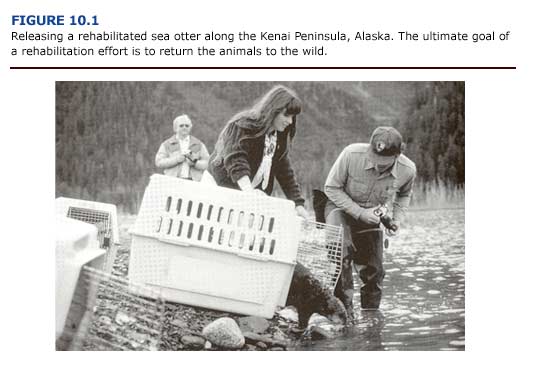
The objective of this chapter is to review alternative strategies for the disposition of rehabilitated sea otters. Our assumption is that returning as many animals to the wild as possible, whether it be for humanitarian or biological reasons, is the ultimate goal of this effort (Figure 10.1).

Fig10.1

ch10-release

Release Alternatives

In addition to a no release alternative, there are four alternatives in release of rehabilitated sea otters: 1) release at the site of capture, 2) release in the general vicinity of capture, 3) relocation to an area already inhabited by sea otters, or 4) relocation to an area uninhabited by sea otters. Each will result in costs and benefits to sea otter conservation.

No Release

In terms of preventing the possible introduction of any domestic or exotic animal diseases into the wild sea otter population, the most conservative approach would be not to release the animals. If this decision is made, then the only alternatives are placing the animals in zoos, aquaria, or research facilities or to euthanize them. If the number of rehabilitated animals is small (ten or fewer), their placement in such facilities may be feasible. Although several facilities are willing to temporarily care for oiled or young sea otters on an emergency basis, most have little or no need for additional wild-caught sea otters. During the EYOS, thirty-seven sea otters, either because of age or health, required permanent care in captivity. Nine of these heavily oiled otters died in April 1989. Another 197 sea otters were rehabilitated to the point that release was recommended. Placement of that many animals in aquaria was impossible. Given the constraints of existing space, a no release alternative is feasible only if few animals are in need of placement. Clearly, permanently holding large numbers of sea otters would require construction of additional holding space. Euthanasia, although not a preferred option for healthy sea otters, must be considered for unwanted, impaired, or unhealthy animals.

Release at Capture Site

We assume in this discussion that only sea otters that are oiled will be captured and, therefore, that the capture sites will have been oiled or located adjacent to oiled areas. In many respects, the release of sea otters near their capture sites is preferred because the animals will be familiar with areas normally used for feeding, resting, pupping, and protection from inclement weather. However, release at capture sites could be precluded by contamination of local habitat. Although release at the point of capture may contribute to research objectives, it may not be in the best interest of the released animals. Barring such research, long-term holding of sea otters while the environment cleanses itself may be required if this option is selected.

Release in General Vicinity of Capture

Releasing sea otters in unoiled areas relatively close to the original capture sites (e.g., within 30-80 km) may minimize the detrimental effects of placing the animals in an unfamiliar area. If the animals are released into familiar habitat, they may remain in the area, thereby enhancing their chances for surviva1. However, it may be difficult to keep the sea otters from reentering oiled areas. The relative benefits of releasing otters near their original capture sites, which may still suffer from oiling, to minimize relocation effects (see below) cannot be determined at this time. Certainly, the severity and geographical extent of the oil contamination would have to be considered. Assuming that damage to the habitat from oil is not extensive, release close to the original capture area may pose the lowest risk to individual animals.

Relocation to an Area Inhabited by Other Sea Otters

The risks of relocating sea otters into areas inhabited by other sea otters are not known. By relocation, we refer to transporting sea otters to areas outside of their home range. Home ranges of sea otters vary in size and are not known with certainty. However, radio telemetry studies of sea otters suggest that the maximum extent of their home range can be measured in tens of kilometers, as opposed to hundreds or thousands of kilometers. Information on the success of relocations comes largely from programs to reestablish populations in areas where sea otters were historically found (Jameson et a1., 1982; Rathbun et a1., 1990). Relocation and release into areas already occupied by sea otters may minimize the detrimental effects of relocation and ensure that the area is generally capable of supporting them. However, the risk of disease transmission is higher.

Release into an area already occupied by sea otters does not guarantee a favorable response from the public, especially if commercial, subsistence, or recreational fishing operations are potentially affected (Rappoport et a1., 1990). Moreover, relocated sea otters may not stay in the vicinity of the release site. Evidence from Ralls et al. (1992) and Monnett et al. (1990) indicate that some relocated sea otters may travel hundreds of kilometers to return to the vicinity of their capture.

Relocation to an Area Not Inhabited by Sea Otters

Many efforts have been made to transplant sea otters into uninhabited areas, and although the factors involved are not understood, high rates of mortality and disappearance of those animals are typical (Jameson et a1., 1982). The 1989-1991 transplant of southern sea otters to San Nicolas Island in California is a good example. Of the 139 sea otters relocated, only about 12 remained there. At least 10 of the otters died, and a minimum of 31 are known to have returned to the mainland population, a distance of more than 300 km. The remaining sea otters disappeared and are unaccounted for (USFWS, unpublished data). Relocating sea otters, even to areas with abundant food resources, places those animals at increased risk. Within Alaska, because of expansion of natural populations and previous transplant efforts, areas of suitable, unoccupied sea otter habitat are scarce. Release in these areas would likely involve relatively long-distance relocations. Moreover, conflicts with the public may occur if sea otters are released into areas with high shellfish densities which are harvested in commercial, subsistence, and recreational fisheries. Release of sea otters into unoccupied food-rich habitats will likely result in an adverse reaction from some segments of the public.

ch10-Geographical Considerations

Geographical Considerations

The release strategy selected following an oil spill will depend on the geographic location and severity of the spill. For example, after the EVOS, the western portion of Prince William Sound was so heavily oiled that release of sea otters into this area was not considered. Along the Kenai Peninsula, oiled and unoiled areas formed an irregular mosaic, allowing the release of some sea otters into clean bays relatively close to those in which they were captured. This strategy allowed sea otters to be released into areas presumably familiar to them. However, it did not prevent the otters from reentering contaminated areas. If habitats on the Kenai Peninsula had been more heavily affected by oil, it would have been necessary to release the otters elsewhere, resulting in potentially greater relocation-related stress and detrimental effects.